
Master of
Information Technology
A structured postgraduate programme combining advanced ICT study, applied research, professional practice and a choice between coursework-focused and research-focused pathways.
Designed for advanced ICT study
The supplied course outline describes an 18-month, 180-credit Master’s programme delivered online and/or on campus, with two study pathways.
Graduate capabilities
The following outcomes are presented from the supplied programme document, without changing its intended scope.
Learn independently and recognise the importance of continued learning.
Engage in rigorous intellectual analysis, criticism and problem-solving.
Show evidence of advanced knowledge about specialist areas of ICT.
Work effectively in teams and take on leadership roles as needed.
Recognise, evaluate and address ICT-related ethical issues.
Apply acquired knowledge and skills in practical situations.
Communicate effectively orally, visually and in writing.
Analyse and critique ICT research literature.
Undertake further study.
Conduct independent research.
Choose a pathway
The source describes two pathways within the 180-credit programme: one with greater coursework and one with a more substantial research project.
Coursework-focused pathway
Designed for students who want to undertake more coursework.
Research-focused pathway
Designed for students who want to undertake a more substantial research project.
Core and optional papers
Module descriptions and credit values below are derived from pages 2–4 of the supplied course outline.
| Code | Paper | Credits | Status | Focus described in source |
|---|---|---|---|---|
| GAIT801 | Managing ICT Projects and Systems | 15 | Mandatory | Managing ICT projects and systems; research into established frameworks relevant to industry trends. |
| GAIT802 | Researching ICT Issues and Trends | 15 | Mandatory | Critiquing and undertaking research; social impacts of ICT; ethical issues in ICT practice. |
| GAIT803 | Research Proposal | 15 | Mandatory | Literature review, methodology selection and exploration of research ethics. |
| GAIT901 | Research Project | 45 | Optional | Applied research informing professional ICT practice. |
| GAIT902 | Thesis | 45 | Optional | Publishable research about applied ICT. |
| GAIT811 | Business Analysis | 15 | Optional | Analysis of organisational structure and function to improve efficiency and productivity using ICT. |
| GAIT812 | Business Intelligence | 15 | Optional | Strategic use of data warehousing, data mining and data analysis for business intelligence. |
| GAIT813 | ICT Infrastructure | 15 | Optional | Various aspects of ICT infrastructure, including emerging digital technologies. |
| GAIT814 | ICT Quality | 15 | Optional | Methods and techniques used in ICT quality assurance and testing. |
| GAIT815 | ICT Security | 15 | Optional | Security impact on ICT infrastructure; ethical and legal implications; cybercrime; investigation strategies. |
| GAIT816 | Mobile Application Development | 15 | Optional | Creating, marketing and deploying a mobile application. |
| GAIT817 | Web Application Development | 15 | Optional | Developing web services and applications. |
| GAIT818 | Special Topic | 15 | Optional | Critical examination of current developments and emerging issues in a specified topic area. |
| GAIT819 | Applied Project | 15 | Optional | Applying appropriate ICT techniques and technologies to solve a non-trivial problem in a business, educational, industrial or similar setting. |
Entry information
The following requirements reproduce the scope of the supplied document. They should not be interpreted as independently verified current admission rules.
Academic entry
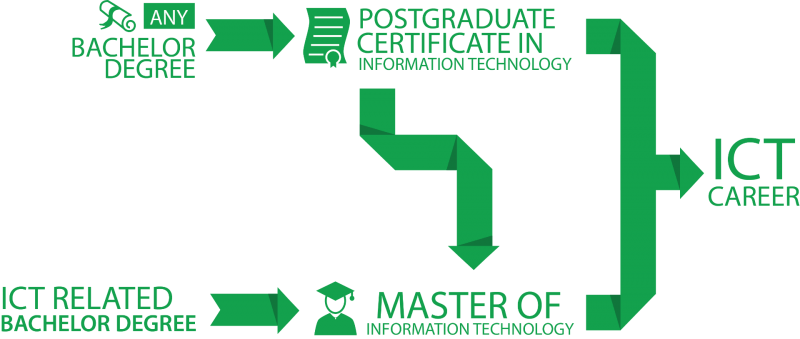
Applicants are described as having completed a bachelor’s degree, graduate diploma, postgraduate certificate or postgraduate diploma in information technology or a related subject, with at least a B grade average at Level 7 or higher.
Special admission
In exceptional circumstances, a mature-aged applicant with evidence of ability to succeed may be considered where an approved course/programme or relevant industry experience meets the required standard.
Provisional part-time admission
An applicant not meeting the academic criteria may be provisionally admitted to one or more papers and may subsequently apply for special or mature entry following successful completion.
English language requirements
The source lists multiple accepted forms of evidence, including prior English-medium study and specified internationally recognised proficiency tests.
- IELTS Academic — 6.5, no band below 6
- TOEFL pBT — 590, with essay score 5.5 TWE
- TOEFL iBT — 79, with writing score 21
- Cambridge English C1 Advanced or C2 Proficiency — 176, minimum 169 in each skill
- OET — minimum Grade C+ or 300 in all sub-tests
- NZCEL — Level 5 requirements as specified in the source
- PTE Academic — 58, no band below 50
- LanguageCert C1/C2 requirements as specified in the source
- Trinity ISE III — no less than pass in any band
Career opportunities described by the programme
The source positions the programme for IT professionals and recent graduates seeking advanced study, further study or preparation for more senior positions.
Programme timetable
The supplied document states that classes are held on campus on weekdays from 9am–4pm and that each paper has one scheduled class per week.
Study → research → professional application
The course outline brings together advanced ICT study, research capability and applied professional problem-solving within a 180-credit Master’s programme.
Develop specialist ICT knowledge and engage with issues, trends, systems and professional practice.
Critique literature, examine ethical issues, select methodology and prepare a research proposal.
Complete an applied research project or thesis, depending on the selected pathway.